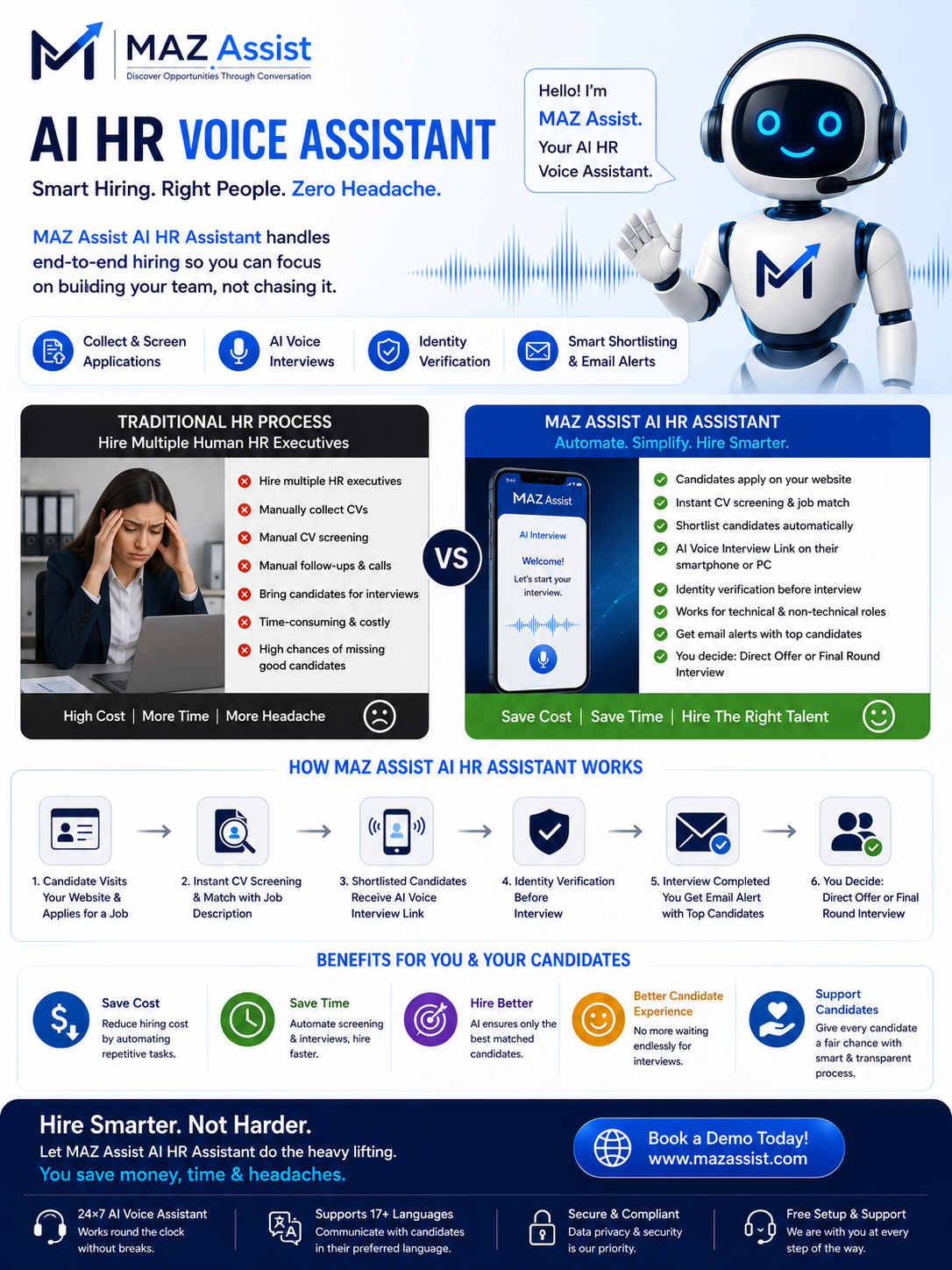
Hiring breaks in the same place at every company: the gap between "we posted the role" and "we spoke to a good candidate". Hundreds of CVs arrive, a handful get read properly, and the best applicants take another offer while your team is still scheduling calls. An AI HR voice assistant closes that gap by running the entire first round automatically.
The four things it handles
- Collect and screen applications from your own careers page.
- Run AI voice interviews in the browser, on any phone or laptop.
- Verify identity before the interview starts.
- Shortlist and alert — you get an email with the top candidates, scores and recordings.
How the workflow runs, step by step
- Candidate applies on your website or hosted careers page.
- Instant CV screening parses the résumé and matches it against the job description.
- Shortlisted candidates receive an AI voice interview link — no scheduling, no coordination.
- Identity verification happens before the interview begins.
- Interview completed — you receive an email alert with the top candidates, transcripts and recordings.
- You decide: direct offer, or a final human round.
Traditional HR process vs AI HR assistant
| Traditional process | AI HR assistant |
|---|---|
| Hire multiple HR executives | One recruiter oversees the pipeline |
| Manually collect and read CVs | Instant CV screening and job match |
| Manual follow-ups and calls | Automatic shortlisting and interview links |
| Coordinate interview slots | Candidates interview whenever they are ready |
| Time-consuming and costly | Minutes per candidate, cents per screen |
| Good candidates slip away | Every applicant gets a fair, fast first round |
What it costs
A five-minute AI voice interview costs a few cents of conversation time plus CV parsing. Compare that with a recruiter's loaded hourly cost multiplied by every 20-minute phone screen that ends in a "no". At 200 applicants a month, the difference is not a line item — it is a headcount.
Benefits for you and your candidates
- Save cost: repetitive screening stops consuming salaried hours.
- Save time: shortlists arrive in hours, not weeks.
- Hire better: identical structured questions per role make candidates genuinely comparable.
- Better candidate experience: no waiting, no ghosting, interview in their own language.
- Fairness and audit trail: every decision is backed by a transcript and recording.
Works for technical and non-technical roles
Structured screens work anywhere the first round is repetitive: support and BPO agents, sales and telecalling, delivery and logistics, retail, nursing and clinic staff, and junior engineering. For technical roles, use the voice round for communication, experience validation and role fit, then keep your hands-on assessment as round two.
Keeping it compliant and human
Three rules keep automated hiring defensible: publish that an AI conducts the first round, keep a human on every rejection above the screening threshold, and store transcripts and recordings so any decision can be reviewed. The assistant filters; people decide.
Getting started
Publish a role, share the careers link, and let the shortlist come to you. Explore the AI hiring assistant, review pricing, or create your workspace. Setup and support are free, and the assistant speaks 17+ languages so you can hire across markets without adding recruiters.