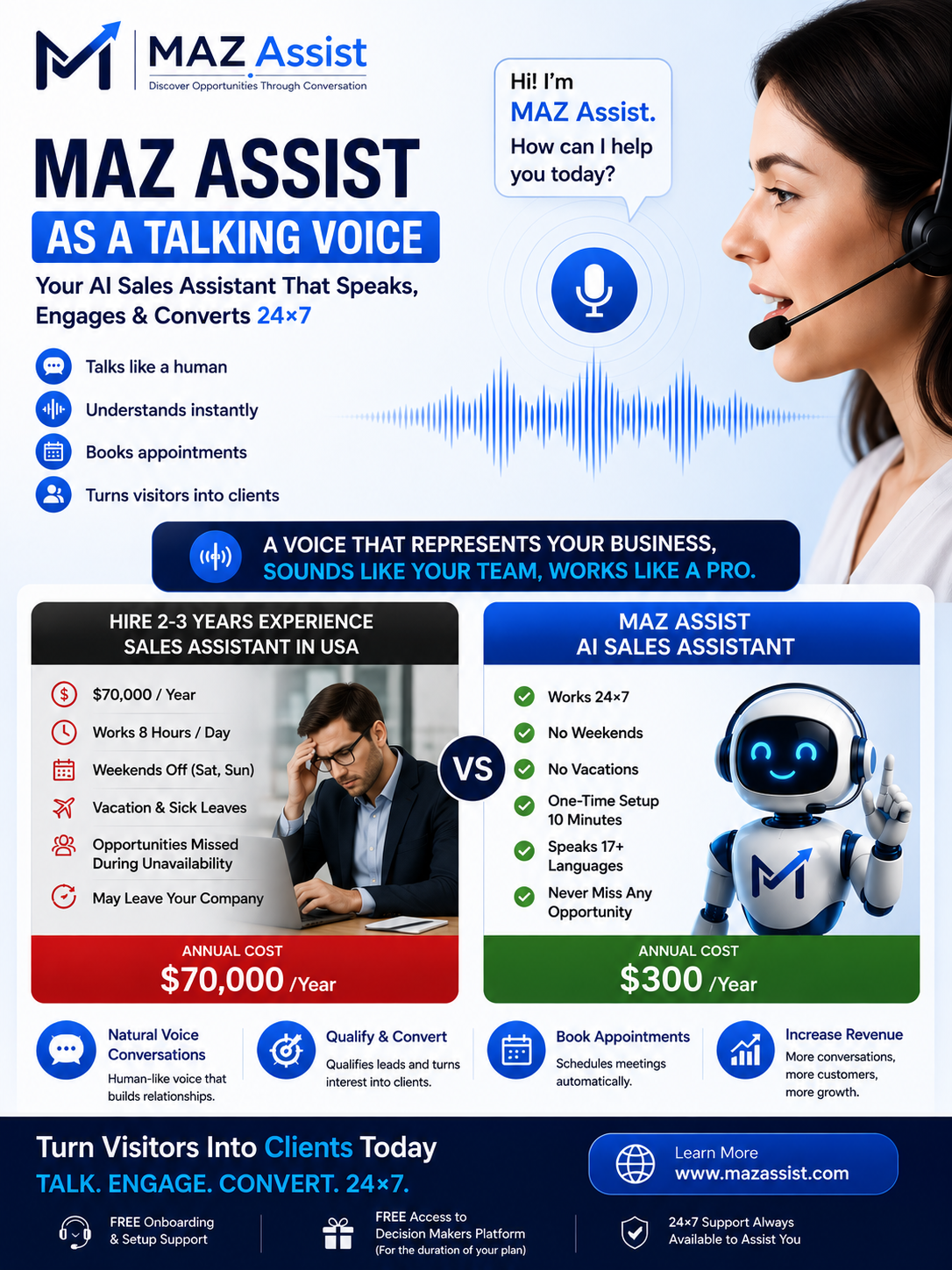
Most websites still treat visitors like readers. They arrive with a buying question, find a contact form, and leave. A talking AI sales assistant changes that: it greets the visitor in their language, answers questions out loud, qualifies the opportunity and books the meeting — 24×7, without a salary.
What a talking AI sales assistant actually does
- Talks like a human. Natural speech with real-time turn taking, not a scripted phone tree.
- Understands instantly. It answers from your own website content, pricing and FAQs.
- Books appointments. Calendar slots are offered and confirmed inside the conversation.
- Turns visitors into clients. Every conversation leaves behind a lead record, transcript and summary.
The honest cost comparison
Here is the comparison most teams never sit down and do.
| Sales rep (2–3 yrs, USA) | AI sales assistant | |
|---|---|---|
| Annual cost | ~$70,000 / year | From ~$300 / year |
| Working hours | 8 hours / day | 24×7, every day |
| Weekends | Off (Sat, Sun) | Working |
| Leave | Vacation and sick days | None |
| Ramp-up | Weeks of training | One-time setup, ~10 minutes |
| Voice options | Usually one | Indian, US or UK English |
| Attrition risk | May leave the company | Never leaves |
This is not an argument to fire your sales team. It is an argument about who handles the first 90 seconds. A rep costs roughly $34 an hour loaded; the first reply to a website visitor is the lowest-value, highest-urgency task you can hand them. Let the assistant do first contact, and let humans close.
Speed to lead is the whole game
Response time is the single strongest predictor of whether an inbound lead converts. Reply inside a minute and your odds of a real conversation multiply; reply the next morning and the prospect has already spoken to a competitor. A voice assistant answers in under a second, at 2am, on a public holiday — the hours where most missed revenue quietly happens.
What "sounds like your team" means in practice
Generic bots fail because they sound generic. A production-grade setup needs:
- Your knowledge, not the internet's. The assistant is grounded in your crawled site pages, service list, pricing and objection handling.
- A defined persona. Name, tone, greeting, and the three things it should always try to achieve in a conversation.
- Qualification rules. Budget, timeline, location, service type — captured conversationally, not as a form.
- A clean handoff. When intent is high or the question is out of scope, it offers a callback, a booking or a live human.
A realistic 10-minute setup
- Create your assistant and let it crawl your website for knowledge.
- Pick a voice and language set, and write the greeting.
- Set qualification questions and where leads should be emailed or sent by WhatsApp.
- Paste one embed snippet into your site footer and publish.
No developer, no telephony configuration, no infrastructure.
How to measure whether it is working
- Conversation rate: share of sessions that start a conversation.
- Qualified lead rate: conversations that produce a contactable, qualified lead.
- Meetings booked: the number that actually matters to revenue.
- After-hours share: leads captured outside working hours — this is pure incremental revenue.
- Deflection: repetitive questions answered without a human.
Where humans still win
Complex negotiation, procurement, custom scoping and relationship-building stay human. The assistant's job is to make sure every one of those conversations starts — with context already gathered — instead of dying in an unanswered form.
Get started
You can put a talking assistant on your site today: see the AI sales voice assistant, compare plans on pricing, or create your workspace and be live in ten minutes. Free onboarding and setup support is included, along with access to the decision makers platform for the duration of your plan.